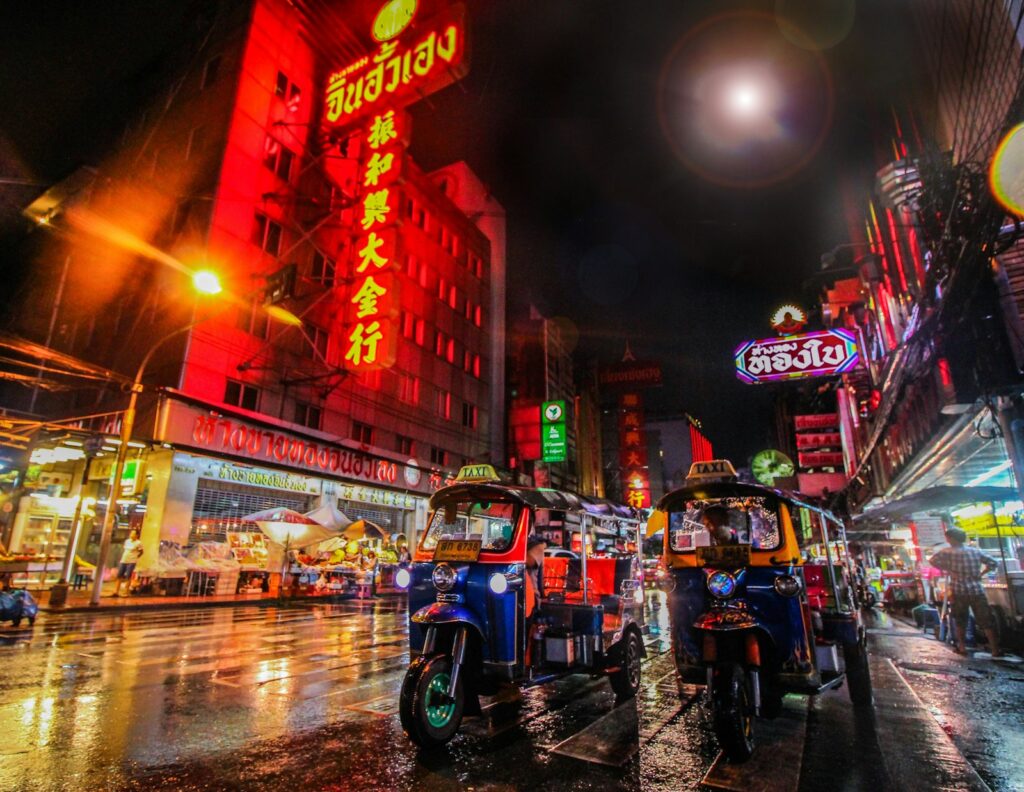
Thailand in 12 Days: Bangkok, Chiang Mai & Krabi
A relaxed twelve days across three very different sides of Thailand: the temples and food of Bangkok, the Lanna culture and elephants of Chiang Mai, and…
From $966 per person
View itinerary
Where the Muslim quarters are, how to read the CICOT mark, and the one app worth downloading.
Thailand is one of the easier Asian destinations for Muslim travellers, and it has been for a long time — the country consistently ranks among the leading non-OIC destinations for Muslim visitors. Estimates of Thailand’s Muslim population range from around 5 per cent officially to as high as 12 per cent by Thai halal-industry reckoning, which is somewhere between four and seven and a half million people.
What follows is the practical layer: where the Muslim quarters actually are in each city we visit, what the certification mark means, and what to ask about in a Thai kitchen.
If you take a single thing from this guide, take this. Halal Route is a free app built by the Halal Science Center at Chulalongkorn University — a genuine academic institution, not a directory scraped off the internet. It maps halal restaurants across more than forty provinces, along with mosques, prayer rooms, prayer times and a qibla compass, and it works in Thai, English and Arabic.
What makes it worth trusting is that venues are audited through on-site visits against recognised halal standards, rather than self-listed. It is the reason this guide names no restaurants: any name we printed would be a snapshot, and the app is maintained.
Bangkok has somewhere in the region of 180 to 200 mosques, and its Muslim communities are old and geographically specific. Knowing the three or four areas is more useful than any restaurant list.
The city’s oldest mosque is generally held to be Ton Son Mosque on the Thonburi bank, founded in the seventeenth century during the reign of King Narai — and it is a short walk or ferry hop from Wat Arun, which almost every Bangkok itinerary includes.
Our Thailand itineraries put the base tier at Al Meroz in Suan Luang, and it is worth explaining why rather than just listing it.
Al Meroz is halal-certified by CICOT and was reported at the time as Thailand’s first fully halal-certified hotel. It is alcohol-free throughout, has its own prayer facilities, and sits beside the Foundation of the Islamic Centre of Thailand. It is on the Airport Rail Link at Ramkhamhaeng, which is a direct run to Suvarnabhumi.
What that changes in practice is the part of a trip that is usually most tiring: breakfast is not a negotiation, there is nowhere in the building you need to check, and prayer does not require planning around. If specific facilities matter to you — gender-separated leisure areas, for instance — ask us and we will confirm current arrangements with the property in writing rather than repeat what was true a few years ago.
Halal certification in Thailand runs through CICOT, the Central Islamic Council of Thailand, whose legal standing comes from the Administration of Islamic Organization Act of 1997. The Sheikhul-Islam, appointed by the King, chairs it, and it draws on representatives from thirty-nine provincial Islamic councils. Certification regulations were set as a national standard in 2001, and the use of the halal logo was formalised in 2009. It is supported by the Halal Standard Institute of Thailand and the Halal Science Center at Chulalongkorn University.
One point that matters especially to Malaysian travellers: CICOT is the only Thai certifier recognised by JAKIM.
The mark itself is a diamond frame containing the word halal in Arabic script, usually in green and usually accompanied by Thai script. Rather than trying to teach logo forensics, we would give travellers two reliable signals: the CICOT mark displayed on the premises, or a visibly Muslim-run kitchen. Thailand has thousands of certified restaurants nationally, so both are common.
Thai food has an unusually good claim on Muslim travellers’ attention: massaman curry takes its name from “Mussulman”, the old word for Muslim. It is generally traced to Persian and Indian Muslim traders, with one strand of scholarship linking it to the seventeenth-century Ayutthaya court and the Persian merchant Sheikh Ahmad Qomi. Its cardamom, cinnamon and cloves are not native Thai flavours — they arrived with Muslim trade. It contains no pork by origin.
Other dishes routinely found at Thai-Muslim kitchens include khao mok gai, Thai chicken biryani; roti in its various forms; satay; and in the north, khao soi.
The things to ask about:
On fish sauce and shrimp paste specifically: whether these are acceptable is a matter of difference between the schools rather than a settled question, so we flag them for you to weigh rather than ruling on them.
Suvarnabhumi has Muslim prayer rooms in both landside and transit areas, including in the newer midfield satellite terminal, and Don Mueang has a prayer room too. We have not printed floor numbers: the airport is mid-expansion and third-party sources disagree with each other. Ask at an information desk, or use the Halal Route app, which maps prayer facilities as well as restaurants.
Several of Bangkok’s major malls provide prayer rooms, including Siam Paragon and ICONSIAM. Locations and hours move, so again — check the app rather than a blog.
Both appear in our twelve-day Thailand journey, and both have a genuine Muslim quarter, which makes them far easier than their reputation suggests.
Chiang Mai’s Muslim life centres on Ban Haw Mosque in the Chang Klan quarter, close to the Night Bazaar. It was built in 1916 by Yunnanese Chinese Muslims — the Chin Haw — and is the largest mosque in the province. The lanes around it concentrate halal kitchens, including Yunnanese Muslim cooking and halal khao soi, which is worth seeking out specifically.
Krabi is the surprise for most visitors. It has by far the largest Muslim population share of any mainland Thai beach destination — around a third of the province at the last census that recorded religion, against roughly one in six in Phuket and one in twenty-five in Bangkok. Halal food is widely available in Krabi Town and Ao Nang, including at the night market, and there are mosques in the Ao Nang area as well as in town. For a Muslim traveller, Krabi is materially easier than the better-known island destinations.
The Grand Palace and Wat Phra Kaew enforce the strictest dress code in Bangkok, and enforcement is real — people are turned away daily. Shoulders and upper arms must be covered, legs covered below the knee, and nothing see-through or tight. The detail that catches people out: a scarf draped over a sleeveless top is not accepted. You need actual sleeves. Cover-ups can be hired at the entrance but do run out at busy times. Wat Pho applies the same principles slightly less strictly, and shoes come off inside the Reclining Buddha hall.
There is a happy coincidence here: modest dress of the kind many Muslim travellers already wear satisfies Thai temple codes comfortably. Hijab is not an issue at temples. Hats and sunglasses should come off inside temple buildings.
On timing, central Thailand runs three seasons: cool and dry from November to February, which is the comfortable window and the peak; hot from March to May; and the rainy monsoon from June to October, when roughly four-fifths of the year’s rain falls. Note that the Andaman coast — Krabi and Phuket — follows a different monsoon pattern from Bangkok, so a single “best time” for a multi-city trip is always a compromise. Ask us and we will tell you what the trade-off is for your dates.
A relaxed twelve days across three very different sides of Thailand: the temples and food of Bangkok, the Lanna culture and elephants of Chiang Mai, and…
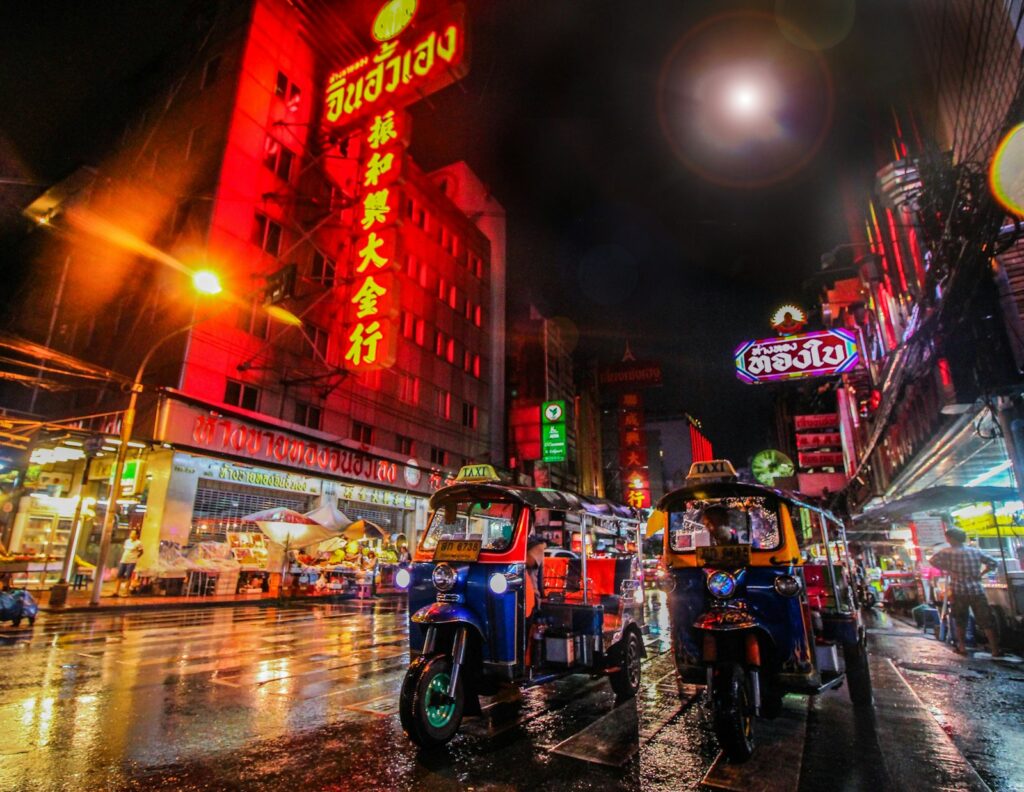
Discover the timeless wonders of Thailand’s capital on a six-day journey through Bangkok and beyond — dazzling royal temples, a dinner cruise on the Chao Phraya,…
A tropical retreat on Thailand’s south coast: five nights in Phuket with a half-day landmarks tour, a full-day joint speedboat excursion to the Phi Phi Islands,…
Yes, more so than most Asian destinations. Thailand has thousands of CICOT-certified restaurants, established Muslim quarters in Bangkok, Chiang Mai and Krabi, and a Muslim population somewhere between four and seven and a half million. The practical tool is the Halal Route app from Chulalongkorn University’s Halal Science Center, which maps audited halal venues, mosques and prayer rooms in English and Arabic.
The CICOT mark: a diamond frame containing "halal" in Arabic, usually green and usually with Thai script alongside. CICOT is Thailand’s national certifier and the only one recognised by Malaysia’s JAKIM. In practice the two reliable signals are the mark displayed on the premises, or a visibly Muslim-run kitchen.
Pork lard used for frying, and chicken or pork stock in noodle soups, are the main ones — they can be present where no pork is visible. Shrimp paste is the base of most curry pastes and disappears into the dish; fish sauce is in nearly everything savoury; oyster sauce is in most stir-fries. Whether fish sauce and shrimp paste are acceptable differs between the schools, so we flag them rather than rule on them.
More than most visitors expect. Krabi has the largest Muslim population share of any mainland Thai beach destination — around a third of the province — with mosques in Krabi Town and the Ao Nang area, and halal food widely available including at the Ao Nang night market. It is materially easier than the better-known island resorts.
The name derives from "Mussulman", the old word for Muslim. It is traced to Persian and Indian Muslim traders, with one account linking it to the seventeenth-century Ayutthaya court and the Persian merchant Sheikh Ahmad Qomi. The cardamom, cinnamon and cloves came with Muslim trade rather than from native Thai cooking, and the dish contains no pork by origin.
Last verified by our team on 20 August 2026.